Training Cycle: Maintenance & Asset Management
This complete cycle of 20 sessions (19 training modules + 1 exam) will give you access to expert know-how, with a strong focus on practical cases, exercises and great interaction. The dynamics that are created in each group after a few sessions are of great value to many participants.
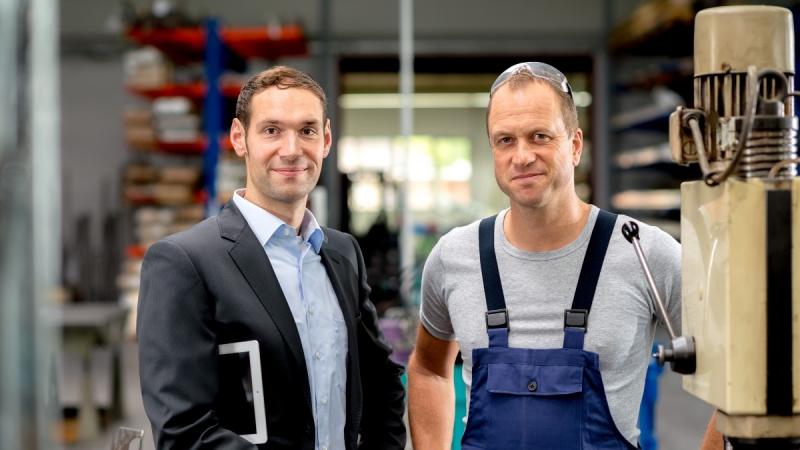
Every edition starts at the beginning of October and runs until spring the year after. The cycle starts with a full day kick-off session with the Maintenance Business Game. After the final session, there will be an examination session where participants can demonstrate their acquired knowledge.
Why participate in this training?
In Belgium, there is no fully-fledged master's level training for maintenance and asset management. The industrial environment is becoming more and more complex and investments in production tools are increasingly measured. At the same time, retirements are accelerating and technical talent at all levels is sorely lacking. In this changing world, creating added value through maintenance and asset management is a challenge. Training within the company is also complicated by lack of manpower, lack of time and dwindling financial resources.
Industrial maintenance management and asset management are complex areas in terms of management and developments tend to accelerate the attractiveness of the sector in terms of development. All this made us realise that we had to offer a complete programme to the new generation of maintenance and asset managers.
Our aim is to share your knowledge and experience, to spread new ideas and to ensure that they can add value to your business. At the same time, we are convinced that this training can be an excellent asset for your professional career within the company.
Translated with www.DeepL.com/Translator (free version)
Who is this training for?
This training cycle is aimed at junior maintenance managers and "high potentials" who have the ambition to move into a technical management position. This training cycle is also a great added value for maintenance engineers with little background and knowledge, technical profiles who will take charge of reliability projects, production managers and anyone who would like to deepen their knowledge in the concepts of maintenance management, reliability and asset management.
In addition to the important theoretical models on maintenance, reliability, maintenance management and asset management, we also provide very concrete tools and solutions that you can immediately apply in your company. You will learn how a maintenance department works; you will learn how to manage the maintenance budget; you will learn how to identify and achieve cost reductions quickly and efficiently.
Overview of the training cycle
- 20 sessions, each on Tuesday afternoon (full day on the first day)
- Starts in October, runs until May.
- Theoretical courses supplemented by a set of books and exercises
- Includes participation in the interactive business game "The GAME
- Quality trainers: a mix of BEMAS trainers, maintenance consultants and experienced maintenance managers.
In practice
- Each session takes place on a Tuesday afternoon (usually from 13:00 to 17:00)
- The first session is exceptionally a full day: the Maintenance Business Game
- After the last session, there is an exam to demonstrate your new knowledge
- You can choose to follow the complete training cycle or to follow one or more modules of your choice.
Session 1: Maintenance Business Game (8h)
This is a unique day on the introduction to the world and philosophy of Maintenance.
After a short explanation of the Value Driven Maintenance (VDM) methodology, several teams of 4 to 6 people will compete against each other in a maintenance game unique in Belgium.
During this interactive game, the VDM ® methodology will be used to adapt the orientation of your virtual maintenance department to new challenges. Participants can take away experience from this game and use it to clearly demonstrate the value of maintenance within their own organisation and to identify where opportunities for improvement may exist.
Session 2: Maintenance process and flow (4h)
Content
- Introduction
- Link with the VDMXL model
- How to represent a process?
- SIPOC model
- SWIM-line model
- How to link roles and responsibilities to process mapping via RA(S)CI?
- The link between processes, the organisation and the IT tool
- How to pilot a process
- Determining what you measure in the processes
- How to build an improvement plan?
- Practical exercises
- Mapping a process in your company
- Establishing roles and responsibilities
Session 3: Skills. Link between soft skills and hard skills (4h)
Technical jobs are complex and require strong skills that are fundamental to improving business performance.
Your job is evolving, between technical and specialised knowledge (aptitude, interpersonal skills), you are at the heart of continuous improvement and teamwork allows you to better achieve a common goal and better results.
Session 4: Operational Excellence: TPM & Autonomous Maintenance
Learning objectives
- Acquire a macroscopic knowledge of the TPM approach
- To be able to establish an equipment improvement strategy
- Understand the interactions between the different Maintenance - Production departments
- How to establish and manage an autonomous maintenance plan
Session 5: Technical knowledge of equipment: Management & execution (4h)
Good technical document management helps a company to increase the reliability of its operations.
How to adopt effective document management, understand its importance and how to implement this sometimes complex system?
Session 6: RCA reliability, root cause analysis (4h)
Content
- What is reliability engineering?
- What is Root Cause Analysis?
- Simple methodology :
- 5 "Why?". Identifying the root causes of a problem in several "why?
- Definition and pitfalls to avoid
- Practical examples
- QQOQCP
- ISHIKAWA (or fishbone)
- Definition
- Practical examples
- Faillure tree
- Definition
- Practical examples
- Application to concrete examples
Session 7: RCM reliability - FMECA (2 x 4h)
Reliability Centred Maintenance (RCM) is different from standard practice. It is an industrial maintenance technique based on the analysis of system functions. How to understand the RCM and FMECA management methods and how they can be used to build a maintenance plan?
Session 8.1: CBM reliability, Condition monitoring & Asset Health (4h)
Applications covered by ultrasound technology
With appropriate technologies such as Condition Monitoring and Asset Health, you can determine the nature of fault conditions well in advance of plant failures. By improving the reliability of your equipment with the best possible approach, not only is the performance better but the cost is lower.
Session 8.2: CBM reliability, Condition Monitoring & Asset Health - Vibration analysis and maintenance 4.0 for all
Theory and practical training
Learning objectives:
- What is vibration analysis?
- Vibration due to mechanical failure
- How is the vibration spectrum created?
- Mains and battery power
- GDPR compliant systems
- Configuration tools
- Equipment hierarchy
- Setting
- Task parameters
- Analysis interface
- Diagnostics
- Display
- Reporting
- History
- Planning tool
- Control Room
- Dashboard
- Location of sensors
- Alarm visualisation
- Concrete examples
Session 9: Maintenance 4.0 (4h)
The transition to Industry 4.0, or Smart Industry, is now a central concern for many companies in all industrial sectors.
In fact, the evolution of technologies makes it possible to make available, in real time, all the data collected within a company, whatever the source: ERP, CMMS, PLCs, supervision systems, variable speed drives, instrumentation, specialised sensors, etc., but also the machines themselves. This hyper-connectivity makes it possible to significantly improve the performance of the maintenance function and, consequently, its overall efficiency by improving the availability and reliability of the machines but also by guaranteeing the required level of operational excellence. This process of digitalising maintenance requires a controlled and structured approach, as well as the implementation of "prerequisites", without which the efforts made will generate more frustration and constraints than benefits.
This training will give you the keys and methods to successfully carry out this digital transition within your company. On the basis of the D4.0 demonstrator, a hyper-connected didactic machine, various applications of digitalization in maintenance will be shown to you on the basis of implemented practical cases: AI, AR, dynamic integration of the CMMS, etc.
Session 10: Maintenance in complete safety (4h)
Managing health, safety and environmental risks in maintenance activities contributes to the creation of added value for your company.
Indeed, reducing costs related to accidents, absenteeism, waste generation and energy inefficiencies contribute fully to the profitability of the company of the future.
What are the real issues and what winning strategy should be implemented to manage HSE (Health, Safety and Environment) aspects effectively?
Two essential tools:
- Risk analysis: essential principles
- Regulatory monitoring: how to ensure compliance with legal, external and internal requirements
Three methods of action :
- Prevention
- Protection
- Precaution
Session 11: Preparation and planning of maintenance work (4h)
Content
- Introduction
- The different processes, related roles and responsibilities
- Processes for managing maintenance interventions
- Work identification
- Approving work orders
- Priorities
- Work preparation
- Work preparation, the different aspects of good preparation
- Work preparations for High Precision Maintenance (HPM)
- Human error
- Guidelines for target values for precision engineering interventions
- Examples of prepared work orders
- Planning of interventions
- The planning management process
- Why plan?
- Multi-term planning, long-term planning
- Planning tools
- Indicators in the Preparation & Planning process? maintenance backlog
- Exercises
- Setting up and using a prioritisation matrix
- Carry out a complete preparation of a complex intervention in a group
- Calculation of work in progress and long-term planning
Session 12: Preparation and planning of major shutdowns (4h)
Content
- Printing a shutdown in practice
- Initiating a major shutdown
- Team models in a major shutdown
- Managing the project scope
- Preparing the work in a shutdown
- Scheduling and planning work in a shutdown
- Management during the execution of a major shutdown
- Evaluation and performance indicators of a major turnaround
Session 13: Service procurement management (4h)
Managing service purchases is a key issue for your company.
How to anticipate risks? How to optimise contract management and implement the inherent tools? BEMAS offers you a 4-hour training course on your purchasing management needs.
Content
- Definition of outsourcing
- Type of outsourcing :
- capacitive
- of specialisation
- structural
- Types of contracts
- Contract of means
- Result contract
- Performance contract
- PBC - Performance Based Contract
- Service Level Agreement
- RACI matrix
- The outsourcing process
- Some Bench Marks
Session 14: Spare parts management(4h)
Learn how to better manage stocks, prioritise equipment...
In maintenance, a structure is necessary: budget, risk analysis, maintenance plans, technical characteristics, technical performance...
Having a high stock level is an expensive insurance policy. Critical spare parts are usually expensive parts that are rarely used and stocking them is often difficult to justify. One of the challenges is to find the right balance between storage costs and the cost of risk.
Session 15: CMMS & Performance Measurement (4h)
The objective of a CMMS is to optimise equipment, obtaining maximum performance at minimum cost.
There are many advantages for the management of the maintenance department and for the technician who will have :
- a clear view of the work to be carried out
- availability of information for the execution of his work
- accessible documentation
- automated recording
- live feedback
Session 16: Use of the production tool
Nothing is more valuable than keeping your production equipment running.
But how?
Content
- The Deming wheel of asset utilisation
- Measurement and analysis of losses
- What is availability and unavailability: types and definitions
- What is uptime?
- What is OEE (TRG)? (introduction to the subject)
- What is failure frequency rate, MTBF and MTBM?
- The difference between MTBF and MTTF?
- What is maintainability, MTTR and MDT?
- The relationship between availability, MTBF and MTTR (formula)
- First introduction to TPM: The 8 pillars of TPM (not in detail)
Session 17: Asset Management
Content
1. The essential building blocks of Asset Management
- Understanding the field of Asset Management
- What to do: the ISO 55000 framework
- Asset Management Policy & SAMP
2. Asset data, asset condition, asset criticality
- What information do you need for Asset Management?
- How do you ensure that this data remains up to date?
- How do you monitor the condition of your assets?
- How do you determine a critical asset?
3. Risk Based Decision Taking and Investment Project Decision Making
- How do you make asset ageing visible/measurable?
- How do you define the measures?
- How to make the right choice of projects based on business cases and risk matrix?
- Building a Long Term Asset Plan and/or Asset Life Cycle Plan
4. Asset Management in the context of ISO 55500
- Setting up the Maintenance & Asset Management system: organisation of processes, IT,
- How does an ISO 55000 certification process work?
- How to measure compliance with ISO 55 000?
Session 18: BEMAS exam (2,5h)
The exam is only for participants who follow the entire Maintenance & Asset Management Training Cycle.
"What struck me during this complete cycle is the scope that complete maintenance management can represent. This training cycle has the merit, in addition to being a complete training given by "field" experts, of putting "field" actors face to face who can exchange their maintenance experiences specific to their field of activity and their maintenance management philosophy."
Documentation
For each session, you will be provided with the teaching material, the course, notes and exercises.
In addition, this course is accompanied by a wide range of reference materials*:
- List of maintenance acronyms and definitions
- VDM XL - Value Driven Maintenance & Asset Management (Mark Haarman & Guy Delahay)
- RCM 3: Risk-Based Reliability Centered Maintenance (Marius Basson)
- Maintenance 4.0 Implementation Handbook (D. Almagor, D. Lavid, A. Nowitz, E. Vesely)
- Maintenance, Tools, Methods and Organisations for Better Performance (François Monchy, Claude Kojchen)
*This list is indicative. A book from this list may be replaced by an appropriate alternative in case of (temporary) unavailability.
"This training cycle allows us to cover all the essential components of maintenance. The trainers skilfully mix theoretical training with their own extensive field experience. The opportunity to discuss one's own experiences with other participants makes the course even more interesting. It also allows you to develop your network of contacts with leading professionals in the various fields of maintenance."
Participation
The participation per participant, including lunch, syllabus and book pack:
- € 6,595 for employees of BEMAS member companies
- € 7,295 for non-members
These amounts are exclusive of VAT. On the invoice, the components (participation, catering, books, ...) will be allocated according to the corresponding VAT rate.
Keep me posted
BEMAS Corporate Sponsors