
The 6 indicators of an effective acoustic lubrication programme
Acoustic lubrication is one of the 8 fundamental applications used in the implementation of effective ultrasonic programs. And it is one of the most important. Poor lubrication practices are responsible for at least 40% of premature bearing failures. Using ultrasound to assess lubrication needs and schedule grease change intervals reduces this figure to 10%. Do you have any idea what impact a 30% reduction in bearing failures would have in your company?
Applying modern methods of conditional bearing lubrication is becoming essential.
Recent advances in this field are transforming the way we look at lubrication tasks. The successful implementation of an acoustic lubrication programme will ensure the success of your business. Less maintenance costs, less grease consumed and less unscheduled downtime will open up new opportunities for maintenance teams, including improved efficiency throughout the plant. Properly maintained and lubricated bearings operate more efficiently, consume less energy and have a reduced environmental impact.
These innovative solutions are available to everyone. Are they all being applied in your plant?
Here are 6 signs that your lubrication programme is meeting its objectives
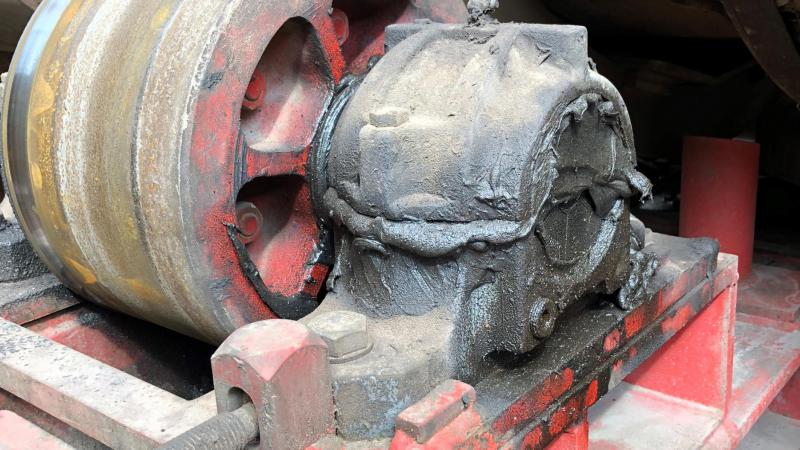
A reduction in the amount of fat consumed
Maintenance departments need to track grease consumption in order to monitor and control their expenses. Analysis of the root causes of bearing failures indicates that over-lubrication is one of the main reasons. Poor practices usually lead to bearings receiving more grease than they need. The excess grease is either drawn into the engine housing or is bled off on the floor! A reduction in grease consumption is a sure sign that your programme is going in the right direction.
Over-lubrication occurs when lubrication intervals are scheduled on a time basis (weekly, monthly...) rather than on the basis of the health of the bearings and the actual grease requirements. Ultrasound helps you to control lubrication tasks by monitoring the condition of the bearings and checking that the level of friction is optimal. This generally increases the time between lubrication intervals, which in turn reduces the amount of grease used.
Overlubricated machines are not only subject to more frequent failures but are also much less efficient. Optimally lubricated bearings consume less energy and contribute to a more environmentally friendly plant. This alone should be motivation enough to lubricate bearings properly!

Fewer lubrication-related failures
Your company needs to monitor failures and perform root cause analysis to eliminate sources of defects.
By optimising lubrication programmes, you can reduce lubrication-related failures. Fewer repairs to make and fewer crisis situations to manage free up time that can be usefully spent on other equally important maintenance tasks to maintain the tool or expand the lubrication program to other machines that are considered less "critical.
In addition, ultrasonics can detect many defects that cannot be identified by trend monitoring alone. For example, clogged or broken grease hoses and poorly connected lubrication circuits that prevent grease from reaching the bearing.
Optimised spare parts management for maintenance, repair and operation
Your new and improved lubrication program means success, better control of grease consumption, fewer failures and improved maintenance productivity. Use the time saved to study trends and better manage your inventory.
Reduce bearing failures and optimise spare parts management. Share your ultrasonic lubrication data with your parts shop manager to create a plan to reduce the number of emergency parts in stock.
And since you manage your spare parts inventory, why not give this task to your suppliers? Ask them to confirm the availability of your emergency parts in their own stocks. If they can supply a part within a day, why keep it in your inventory?
An increase in the number of machines under surveillance
One of the benefits of an effective lubrication programme is time saved.
- Time that can be spent monitoring machines, rather than repairing them.
- Time that can be spent on correctly assessing the actual lubrication requirements.
- Time that can be spent getting the full picture.
Consider, for example, criticality assessment. Many lubrication programmes start with small targets. All critical A machines are given priority, which is normal. What about the others? If you now have more time to plan, organise and schedule, increase the number of machines that are acoustically monitored for optimum lubrication.
Save time. Combine acoustic lubrication and predictive maintenance

Acoustic lubrication is a proven method of ensuring accurate lubrication of bearings. The use of a good ultrasonic lubrication assistant combines lubrication guided by four monitoring indicators with an assessment of the overall bearing health in terms of friction or impact.
The time saved by assessing the condition of the bearings during the lubrication process is invaluable and is further proof that your lubrication program is doing the job right.
Inspectors are increasingly confident
Machine reliability is a reflection of an effective lubrication programme. It is measured by :
- controlled grease consumption
- fewer grease-related bearing failures
- optimised spare parts management
- more machines under surveillance
- longer intervals between data collection.
By integrating ultrasonic technology into your lubrication program, you increase reliability. And reliability breeds confidence. More confident inspectors make better decisions and spread a positive culture throughout the company.
Ultrasonic-assisted lubrication of production tools offers significant benefits that scheduled lubrication at defined time intervals does not. The primary objective of lubrication is to create a thin layer of lubricant between the rolling and sliding elements to reduce friction. It is therefore logical to assume that the best way to determine the lubrication needs of a machine is to monitor the friction levels, certainly not its running time.
Machines that are properly lubricated require less energy to operate. Consider that by reducing your grease consumption, you are also reducing your electricity bills. Machines that use less electricity run cooler and have longer life cycles.
Finally, by monitoring the lubrication status of your machines, you also collect valuable data on the health of your machines themselves. Dynamic and static ultrasonic data combined with 4 monitoring indicators (RMS value, RMS Max value, Peak value and Peak factor) allow for accurate diagnosis of bearing health.
Optimising machine lubrication with ultrasound significantly reduces grease consumption. Effective ultrasonic programmes accelerate the development of a positive corporate culture.
Who could have imagined the benefits of simply moving from time-based to predictive maintenance?
André Degraeve
SDT International sa
andre.degraeve@sdtultrasound.com
www.sdtultrasound.com
BEMAS Corporate Sponsors